

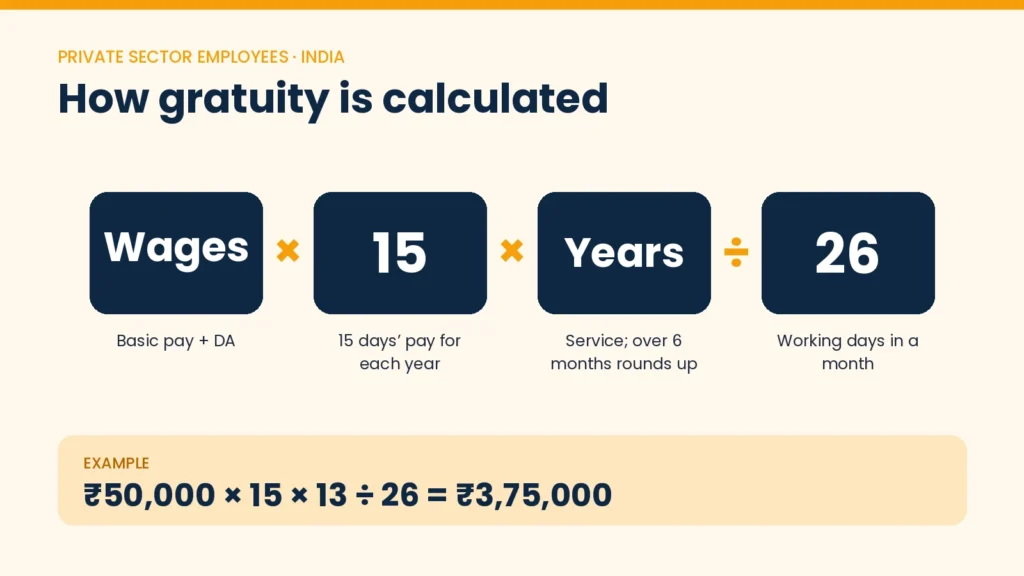
Gratuity for private sector employees is calculated as last drawn monthly wages × 15 × years of service ÷ 26, where wages means basic pay plus dearness allowance (DA). You generally need 5 years of continuous service to qualify, and the amount is tax-free up to a lifetime limit of ₹20 lakh. Since the new labour codes came into force on 21 November 2025, the salary this formula uses has changed for many employees, and in many cases the payout goes up.
This guide covers the formula, who is eligible, how the new 50% wage rule works, how tax applies, and three worked examples you can repeat with your own numbers.
Key takeaways
- Formula: Gratuity = Last drawn wages × 15 × Years of service ÷ 26
- Wages means basic pay + DA + retaining allowance, not your full CTC.
- If your allowances exceed 50% of total pay, the excess is added back to wages. This often increases your gratuity.
- Permanent employees need 5 years of continuous service. Fixed-term employees now qualify after 1 year.
- A part-year above 6 months is rounded up to a full year.
- Gratuity is tax-free up to a lifetime limit of ₹20 lakh for private sector employees, under both the old and new tax regimes.
What is gratuity?
Gratuity is a lump-sum amount your employer pays you as a reward for long, continuous service. It is paid when you leave through resignation, retirement or superannuation, or to your nominee in case of death or disablement.
For decades, gratuity was governed by the Payment of Gratuity Act, 1972. Since 21 November 2025, its provisions sit within the Code on Social Security, 2020, one of India’s four new labour codes. The core formula carried over unchanged. What changed is the definition of the salary it is calculated on, and the eligibility rules for fixed-term staff.
Gratuity is a statutory right. If you meet the conditions and your employer is covered by the law, the employer cannot refuse to pay it, even if your offer letter does not mention it.
Who is eligible for gratuity in the private sector?
Gratuity applies to establishments that employed 10 or more people on any day in the preceding 12 months. Once a company is covered, it stays covered even if headcount later falls below 10.
Within a covered establishment, you are eligible if:
- Permanent employees: you have completed at least 5 years of continuous service.
- Fixed-term employees: you have completed at least 1 year of continuous service under your contract. This is new under the labour codes and applies to service after 21 November 2025.
- Death or disablement: there is no minimum service requirement. Gratuity is paid to the employee or nominee regardless of tenure.
What about 4 years and 8 months? Many employees ask whether leaving just short of 5 years means losing gratuity entirely. Several High Courts have held that an employee who worked 240 days in the fifth year (190 days where the establishment runs a 5-day week) is treated as having completed continuous service for that year. The outcome depends on the facts, and employers do not always accept this without a dispute, so plan your exit date carefully rather than relying on it.
Contract labour hired through a contractor is a separate case. The contractor, as the employer, is generally liable for gratuity after 5 years of continuous service.
The gratuity formula for private sector employees
For employees covered by the law, the formula is:
Gratuity = (Last drawn monthly wages × 15 × Number of years of service) ÷ 26
What each part means:
- 15 represents 15 days of wages for every completed year of service, roughly half a month’s pay per year.
- 26 is the number of working days in a month, assuming 4 Sundays off. Dividing by 26 gives a daily wage.
- Years of service is your total continuous service. If the final part-year is more than 6 months, it rounds up to the next full year. If it is 6 months or less, it is ignored.
So 12 years and 7 months counts as 13 years, while 12 years and 5 months counts as 12 years.
What counts as “last drawn wages”?
This is where most people get the calculation wrong. Gratuity is not calculated on your CTC or gross salary. Under the labour codes, “wages” include:
- Basic pay
- Dearness allowance (DA)
- Retaining allowance, if any
HRA, conveyance, special allowance, overtime, bonus and commission are excluded, with one important guardrail. If the excluded components add up to more than 50% of your total remuneration, the excess is added back into wages. In practice, your gratuity base cannot be less than half of your total pay.
This 50% rule is the biggest change for private sector employees. Many companies kept basic pay low, at 30–40% of CTC, and loaded the rest into allowances to keep gratuity and PF costs down. From 21 November 2025, that structure no longer reduces your gratuity.
Worked example 1: A standard gratuity calculation
Anjali works at an IT services company in Kochi. She resigns after 12 years and 7 months of continuous service. Her last drawn salary:
- Basic pay: ₹40,000
- DA: ₹10,000
- Her allowances are below 50% of total pay, so no add-back applies.
Step 1: Find last drawn wages. ₹40,000 + ₹10,000 = ₹50,000
Step 2: Count years of service. 12 years and 7 months. The 7 months exceed 6, so this rounds up to 13 years.
Step 3: Apply the formula. ₹50,000 × 15 × 13 ÷ 26 = ₹3,75,000
Anjali is entitled to ₹3,75,000. Since this is well below the ₹20 lakh limit, the full amount is tax-free.
Worked example 2: How the 50% wage rule changes your payout
Rahul earns ₹1,00,000 a month, structured as:
- Basic pay: ₹35,000
- HRA, special allowance and other allowances: ₹65,000
He leaves after exactly 8 years of service.
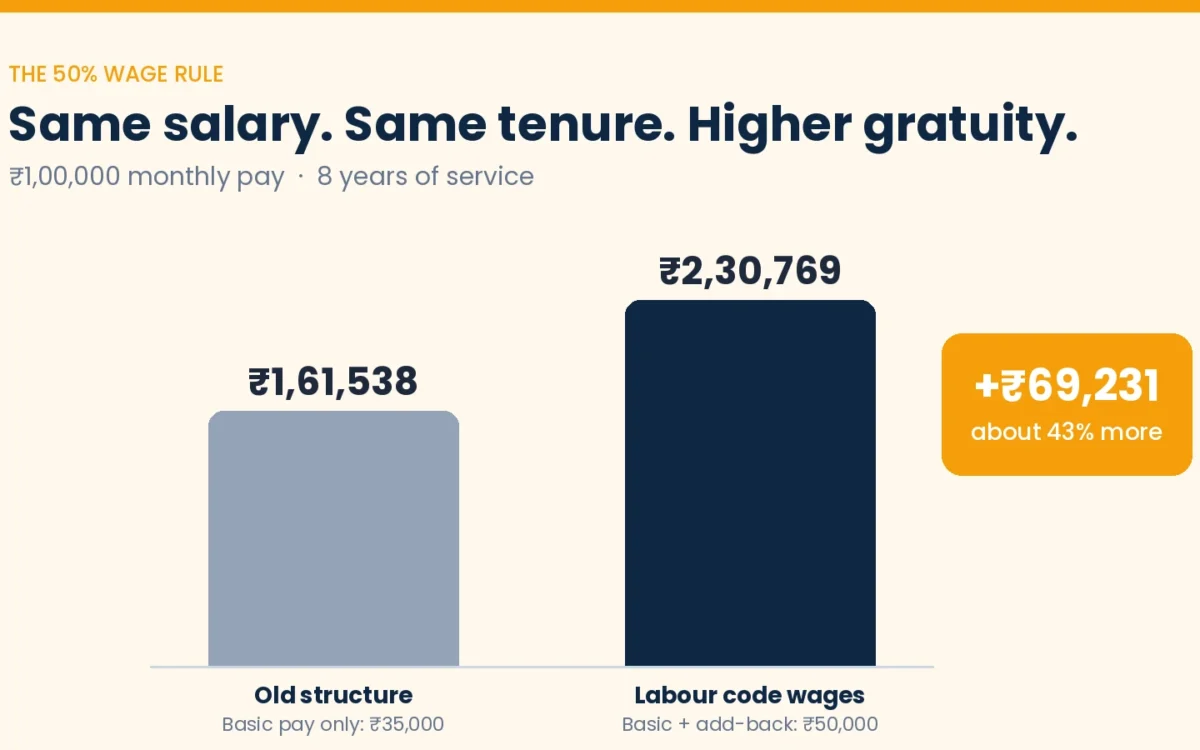
Under the old approach (basic only): ₹35,000 × 15 × 8 ÷ 26 = ₹1,61,538
Under the labour codes: Rahul’s excluded allowances (₹65,000) are 65% of his total pay. The limit is 50%, or ₹50,000, so the excess of ₹15,000 is added back to wages.
Wages for gratuity = ₹35,000 + ₹15,000 = ₹50,000
Gratuity = ₹50,000 × 15 × 8 ÷ 26 = ₹2,30,769
| Calculation basis | Wages used | Gratuity (8 years) |
|---|---|---|
| Basic pay only (old structure) | ₹35,000 | ₹1,61,538 |
| Labour code wages (50% rule) | ₹50,000 | ₹2,30,769 |
| Difference | +₹15,000 | +₹69,231 |
With the same salary and the same tenure, Rahul receives about 43% more. If your basic pay is below 50% of your CTC, check your full and final settlement carefully.
Worked example 3: Gratuity for a fixed-term employee
Meera joins a logistics company on a fixed-term contract in December 2025. She works 1 year and 7 months, and her last drawn wages are ₹30,000.
Under the old law, she would get nothing because she did not complete 5 years. Under the labour codes, fixed-term employees qualify after 1 year, and the 7 extra months round up to a second year.
Gratuity = ₹30,000 × 15 × 2 ÷ 26 = ₹34,615
A fixed-term employee on an 11-month contract does not qualify. At least one full year of service under the contract is required.
Quick gratuity reference table
Use this table to estimate your gratuity from your monthly wages (basic + DA, after the 50% rule) and your years of service.
| Years of service | Wages ₹30,000 | Wages ₹50,000 | Wages ₹75,000 |
|---|---|---|---|
| 5 years | ₹86,538 | ₹1,44,231 | ₹2,16,346 |
| 10 years | ₹1,73,077 | ₹2,88,462 | ₹4,32,692 |
| 15 years | ₹2,59,615 | ₹4,32,692 | ₹6,49,038 |
| 20 years | ₹3,46,154 | ₹5,76,923 | ₹8,65,385 |
| 25 years | ₹4,32,692 | ₹7,21,154 | ₹10,81,731 |
Want to see how gratuity fits into your overall pay? Read our India salary guides for role-wise salary breakdowns.
What if your employer is not covered by the law?
Businesses with fewer than 10 employees are not legally required to pay gratuity. Some still pay it voluntarily under company policy, in which case the amount depends on the employer’s own rules.
For tax purposes, gratuity from a non-covered employer is treated differently. The tax-exempt portion is half a month’s average salary (averaged over the last 10 months) for each completed year of service, with the month taken as 30 days instead of 26. Part-years are not rounded up. The ₹20 lakh lifetime ceiling still applies.
Is gratuity taxable for private sector employees?
For employees covered by the law, the tax-exempt amount is the lowest of these three:
- The actual gratuity received
- ₹20,00,000 (the statutory ceiling)
- The formula amount: last drawn wages × 15 × years of service ÷ 26
Anything above the exempt amount is added to your salary income and taxed at your slab rate.
A few points to note:
- Lifetime limit: The ₹20 lakh is a lifetime cap across all employers. If you received ₹8 lakh tax-free from a previous job, only ₹12 lakh more can be exempt later.
- Both tax regimes: The gratuity exemption applies under the old and the new tax regime.
- New Income-tax Act: From FY 2026-27, the Income-tax Act, 2025 replaced the 1961 Act. The gratuity exemption was carried over, so the treatment above still holds.
- Government employees are different: Their gratuity is fully tax-free, and the central government payout ceiling rose to ₹25 lakh from January 2024. That higher ceiling does not apply to the private sector, which remains at ₹20 lakh.
- Report it anyway: Even fully exempt gratuity must be disclosed in your income tax return. Your employer will show it in Form 16.
When and how is gratuity paid?
Your employer should calculate gratuity once it becomes payable and pay it within 30 days. If the payment is delayed without a valid reason, the employer owes simple interest on the amount.
To keep the process smooth:
- Submit your gratuity claim form to HR along with your resignation or retirement papers.
- Keep copies of your appointment letter, salary slips, relieving letter and bank details.
- Keep your nomination up to date so your family can claim without delays if needed.
Gratuity can be partly or fully forfeited only in specific cases, such as termination for misconduct that caused loss or damage to the employer, or for acts involving moral turpitude. An ordinary resignation does not reduce your gratuity.
If your employer refuses to pay, or pays less than you are owed, you can approach the controlling authority for your area, usually the Assistant Labour Commissioner.
Common mistakes when calculating gratuity
- Using CTC or gross salary. Gratuity runs on wages (basic + DA, adjusted for the 50% rule), not your full package.
- Ignoring the 50% add-back. If your basic is low, your actual gratuity may be higher than a simple calculator shows.
- Getting the rounding wrong. Only a part-year above 6 months rounds up. Exactly 6 months does not.
- Dividing by 30 instead of 26. The 30-day month applies only to non-covered employers.
- Forgetting the lifetime tax limit. Earlier exemptions reduce the tax-free amount available for later ones.
Frequently asked questions
How is gratuity calculated for private sector employees?
Multiply your last drawn monthly wages (basic + DA) by 15 and by your years of service, then divide by 26. If your allowances exceed 50% of total pay, the excess is added to wages first.
Can I get gratuity if I resign before 5 years?
Permanent employees generally need 5 years of continuous service. Fixed-term employees qualify after 1 year, and there is no minimum in case of death or disablement.
Is gratuity calculated on basic salary or CTC?
Neither exactly. It is calculated on wages, meaning basic pay plus DA and retaining allowance, and the base can never be less than half your total remuneration.
What is the maximum gratuity for private sector employees?
The statutory ceiling is ₹20 lakh. Employers can pay more under their own policy, but anything above the exempt limit is taxable.
Is gratuity tax-free in the new tax regime?
Yes. The exemption of up to ₹20 lakh is available in both the old and new tax regimes.
How long does an employer have to pay gratuity?
Within 30 days of it becoming payable. Delays attract simple interest unless the employee caused the delay.
Closing thought
Gratuity is one of the few benefits that rewards staying put, and the labour codes have made it worth more for anyone whose salary leaned heavily on allowances. The day you choose to leave and the way your wages are defined can change the cheque by tens of thousands of rupees, so check both before you hand in your resignation.
This article is for general information only. Rules can vary with your employment contract, state rules and specific facts. For large amounts or disputes, consult a chartered accountant or labour law professional.
